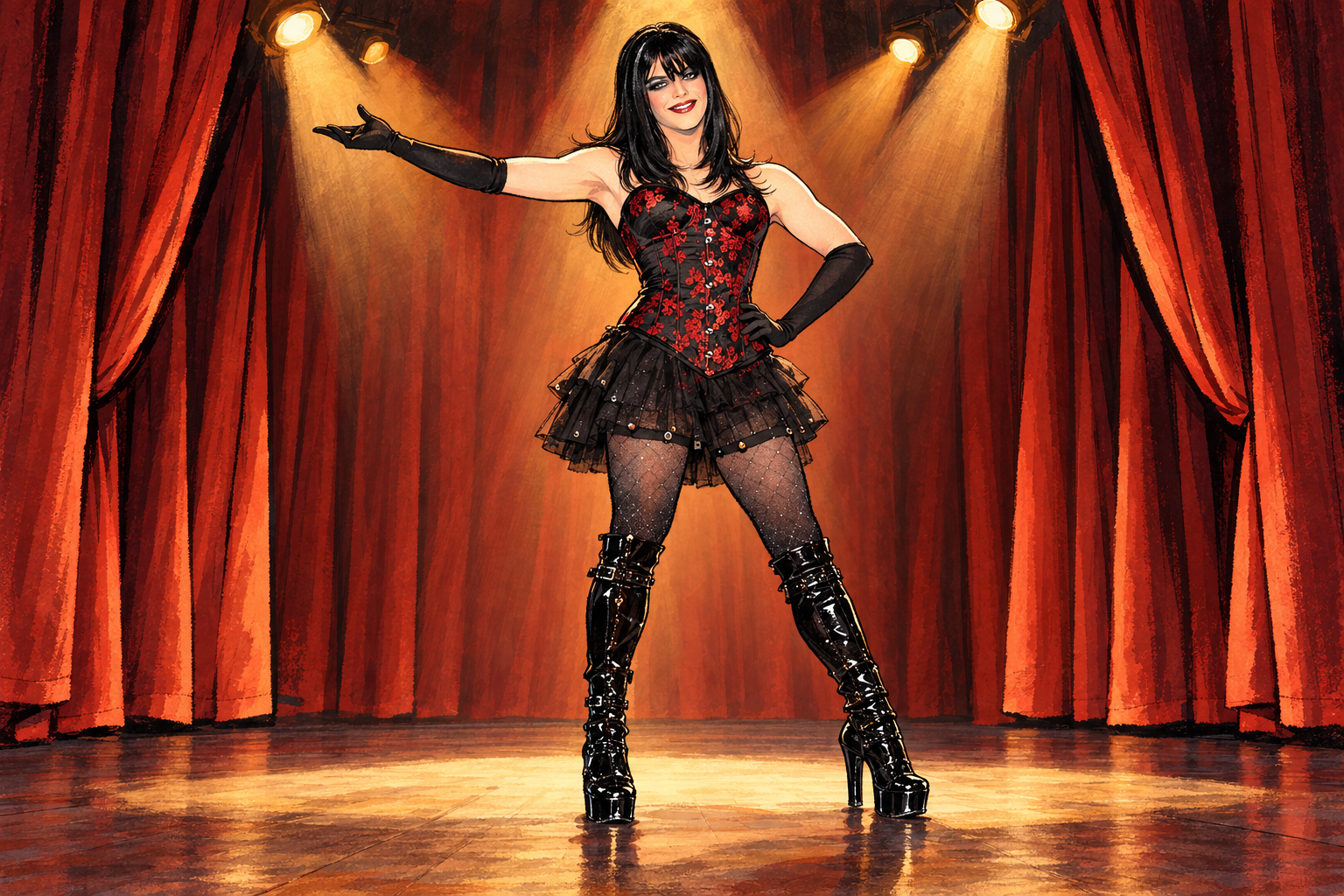
At twenty-two I went to dinner at Pastis in Manhattan on Halloween night dressed entirely as Lucille Ball. The next time I did drag, I hired a choreographer and a makeup artist, built a number to Janet Jackson's "Feedback," and performed it in front of a hundred and fifty people. It was badass. I love that I never do anything halfway.
My friend Juni told me she loves men who embody the feminine. It lets her give someone permission to have what she denies herself. Being a girl, she said, already comes with the risk of being treated as less than a person.
The feminine she adores comes drenched in the blood of a thousand cuts, and she'd rather see a man wear it from the safety of his sex.
I wear it. Life asked me to be masculine and feminine at the same time, in one body. For years, that confused the hell out of me. Now I know it was written into my life's assignment. I'm part of the Pluto in Libra generation, born carrying questions about the rules of fairness, balance, and how we live with one another. What follows is how those questions have played out in one life.
Another white guy in the crowd
If you see me in a crowd, I'm just another white guy. I'm Jewish, but the white disguises it. So I can fit right in with everyone else at roll call. But I am nothing like the others in the crowd.
I didn't know I was gay until I was a teenager. I was a late bloomer, though I always knew I was different from other people. Boys intimidated me. Something came so easily to them as we turned into men—natural masculinity. Built-in instructions on how to be a man. I looked at them, knew I was different, and it felt like a punishment. I spent my adolescent years trying to contain just how much I didn't fit in. Instead, I had more in common with the girls, so that's where I went for friendship. I learned a lot about women by watching my mom. I spent a lot of my childhood Saturdays with her at Neiman Marcus, and I went off to college knowing more about women's handbags than sports. At forty-four I still don't know how you play football.
By adolescence, though, I was beginning to find my own way. My misfit friends and I saw The Rocky Horror Picture Show at the artsy Inwood Theatre in Dallas. I don't know how they let a bunch of twelve-year-olds in, but the Time Warp became our obsession for months afterward. That movie came out in 1975, seven years before I was born, with Pluto in Libra.
It challenged sexual conventions, became a refuge for outsiders, and made it a pleasure to be different.
At seventeen my journalism class traveled to New York, and everyone wanted to see Rent, the scandalous Broadway show. My parents fought hard against letting me go, and I couldn't understand what they thought was waiting for me in that theater. Then the lights went down, and there on the stage, for the first time, was a home for every feeling I'd been carrying around but couldn't explain.
Rent also confronted the devastation of AIDS and a culture that looked away. As I grew up, gay men and women went from something polite people didn't mention to the center of this country's argument about who gets to belong—whether anyone was ready or not. I grew up inside that argument, trying to figure out where I belonged.
Out loud
I came out at twenty. My parents fought it the way they'd fought Rent, and I spent years negotiating (very Libra) a self-identity that didn't feel comfortable until my mid-thirties. Confidence came as I began accepting myself, and as my body matured, so did my connection to masculinity. "Becoming a man" happened to me, not through me.
I got married when it was legal in only a few places. We adopted two children, and I forced myself to live openly and out loud, even though it made me cringe inside for most of my life. I never wanted my kids to see me ashamed of who I am. That's the Pluto in Libra part of me: forced to change, for myself and for them.
In time, I learned to wear both the masculine and feminine, and wear them with ease. Today I think about the years I spent obsessing about whether people thought my man-bag looked too much like a purse. I mean, I have to carry one. You don't graduate from the school of NorthPark Mall without putting that degree to work.
I am not a woman though, and I've never once wanted to be one.
I feel first and think second. I absorb other people's feelings. And right now I'm learning to let things be instead of forcing them. These are qualities I recognize as feminine in myself.
I also lead, compete, and drive my mid-life appropriate sports car ninety-five miles an hour. I provide and I protect — my children and the people who work for me, and at times I fail them. I die trying not to. I am masculine too — just another white guy in the crowd.
It took me a lot of years to see that I get to be both. I used to hate the feminine in me. Now I love embodying it the way I do. I don't know when I finally realized it, but this is my skin, and it's made of me. The features, desires, dreams, needs, fears — I am all of these, so I can't be anything less than all of them.
Pluto in Libra
Astrology describes what life asks of us, and something about the way we'll meet it. The planets describe the forces at work in our lives; the signs describe what those forces are about. But that cosmic map won't tell you how you'll answer. That comes from the part of you that knew who you were before anyone told you, and your only job is to find that part, and be it.
Pluto tears things down and remakes them. In Libra, that transformation concerns fairness, balance, and the rules people live by with one another. In my life, those rules reached all the way into what I thought I was allowed to be.
Because Pluto moves so slowly, millions of people are born carrying the same question. We are seeds of Pluto in Libra, and we grow into it over a lifetime. What I encounter through sexuality and gender, someone else encounters through marriage, relationship obligations, or a fight to be treated fairly. The placement lives in the questions life asks each of us to reckon with, and in the choices we make in response.
None of us starts clean. We're born into a world the generations before us built, and we learn how to operate in that world, long before we can decide for ourselves what to believe. I inherited that world's music, movies, laws, and ideas about what a man should be. My job wasn't to accept or reject that inheritance wholesale, but to hold it up against who I know myself to be, and notice where that didn't fit. The world handed me instructions, I read them, and said "I don't think so."
Today, if you put on "Everybody Wants to Rule the World," I'm eight years old, in the back seat of my mother's 1988 BMW 528e. Graphite, maroon leather, sunroof open, back doors child-locked. She's up front in her sunglasses with her hair flowing, smoking a cigarette, living inside the music the way I do now. That's where my roots are. Nothing will ever move me off of that.
Life doesn't ask just once; it keeps asking through our relationships, conflicts, and the choices we'd rather avoid. The question underneath is always the same: who are you, and who do you want to be next. My children learn how to live with themselves by watching how I live with myself. The world teaches us what's acceptable; living makes us decide how much of that we can accept.
Multiply those decisions by a generation living out Pluto in Libra over a lifetime. Who we love, what we fight for, what we refuse to hide.
Our choices reshape the world that shaped us, and our children inherit those changes, alongside everything we haven't managed to confront.
Waiting for the Wave

Juni carries a rage for the way the divine feminine has been trampled on for thousands of years. She's the one who'd rather see a man wear it, and she still sees a world that punishes her for it.
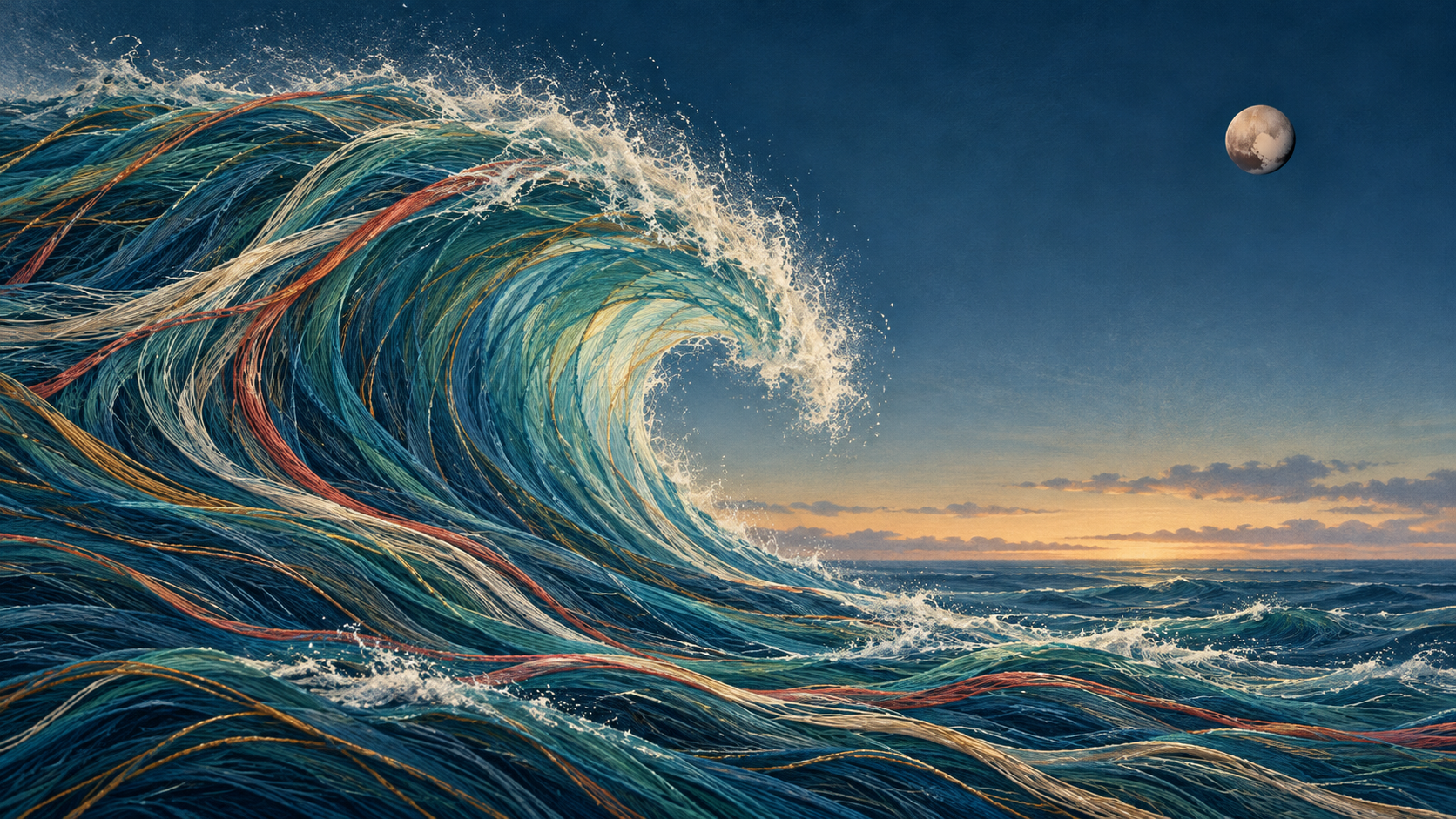
She told me about a dream she had when she was very young. An asteroid hits the planet. A wave takes out half of us, leveling the ground, and out of the wave come these vermilion horses. "I am waiting for that wave," she said.
Her rage is real. I never had rage. Instead, I was suffocating under the weight of figuring out how to move through a world that didn't (yet) accept people like me. My mother told me when I was twenty that she wouldn't love me if I was gay. She knew a world where gay men died by the thousands, and today I know she was trying to protect me.
These are real wounds, and we all have our own to bear. The life I have now would have been difficult for that twenty-year-old to imagine. But as I look around, I can't help noticing how many more people like me there are today than when I was growing up. I feel like I'm doing Pluto's work, and I can see that I'm not doing it alone.
We live inside one lifetime, and it can feel like the whole story, but we're part of one that began long before us and will keep unfolding after we're gone. Juni and I are drops of water in the ocean of people who come here in waves. Her rage and sadness, my shame and freedom from it: all of that is the wave, moving all of consciousness little by little. Individually, you are a ripple. Together, we are the wave.
Juni told me: "I feel like I've been working my whole life only to find I could just be me."
Yeah. Be who you are.
Every time we make room for ourselves in a world that hasn't known what to do with us, we leave more room for whoever comes next.
When Juni said she was waiting for the wave, I told her: don't. We are the wave.